Strategic Analysis of Maritime Registration: Polish vs. Spanish Flag for International Vessel Owners
The global landscape of recreational and commercial maritime registration is undergoing a period of profound regulatory restructuring. For expatriates, international investors, and post-Brexit United Kingdom nationals maintaining vessels in European waters, the choice of flag state has evolved from a mere administrative formality into a highly strategic legal and financial decision. The selection between the Polish flag and the Spanish flag represents a core dichotomy in the maritime world: the choice between bureaucratic streamlining through an open international registry and strict, localized domestic compliance.
Historically, boat owners residing in or navigating the Mediterranean sought out alternative registries to bypass the rigorous technical inspections and stringent safety mandates imposed by national authorities like the Spanish Directorate General of the Merchant Marine (DGMM). With former administrative havens such as the Dutch International Certificate of Pleasure Craft (ICP) invalidated for international waters, and the Belgian pavilion heavily restricting its access exclusively to residents, the Polish maritime registry has emerged as the preeminent European Union flag state. However, for the international market—particularly expatriates residing in Spain and non-EU citizens—the intersection of foreign flagging, local tax residency, and post-Brexit customs law creates a highly complex regulatory matrix. This comprehensive report provides an expert-level evaluation of the Polish boat registration versus the Spanish boat registration systems, meticulously detailing the structural advantages, hidden fiscal liabilities, corporate ownership mechanisms, and the evolving safety compliance landscape for the international maritime community.
The Structural Advancements of the Polish Maritime Registry (REJA24)
The ascent of the Polish flag within the global yachting community is entirely deliberate, engineered through a highly digitized, low-friction administrative framework known as the REJA24 system. Unlike traditional maritime authorities that rely on archaic paper trails and recurring physical inspections, the Polish Ministry of Infrastructure modernized its approach to attract international capital and expand its maritime footprint.
Lifetime Validity and the Eradication of Bureaucratic Attrition
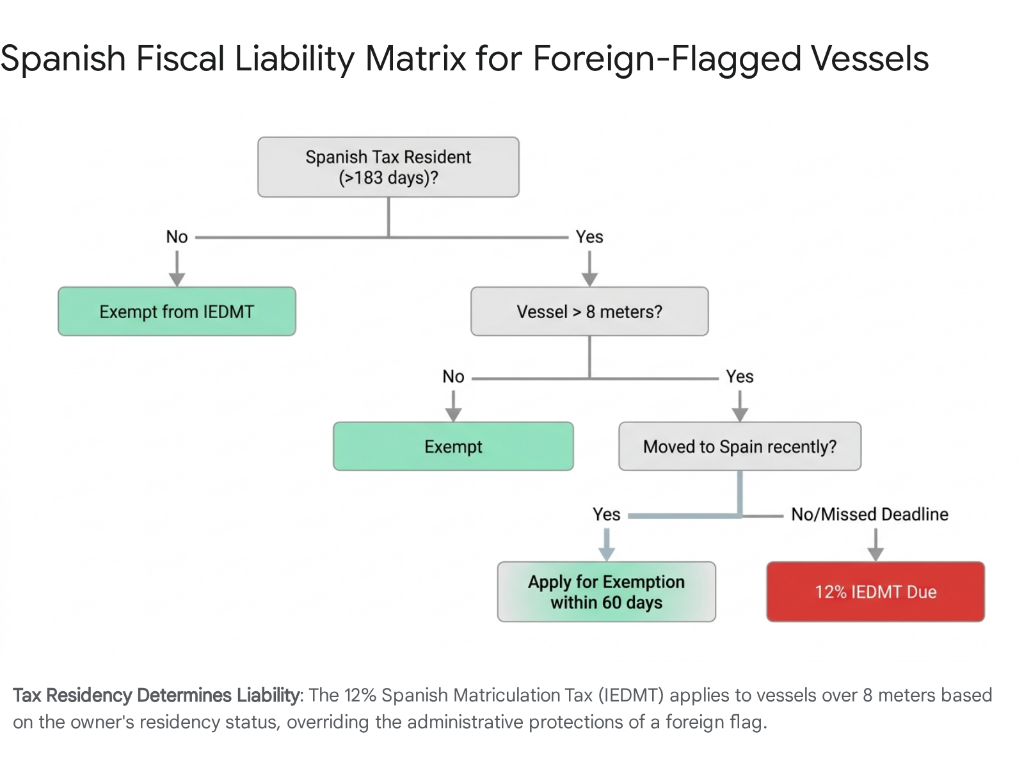
The primary catalyst driving the international adoption of the Polish flag is its lifetime registration validity. The traditional Spanish boat registration system enforces a mandatory renewal cycle and requires a costly technical inspection, known as the Inspección Técnica de Barcos (ITB), every five years for standard recreational vessels. The Polish registration certificate, by contrast, possesses no expiration date under the current legislative framework. This structural permanence eradicates the concept of bureaucratic attrition—the recurring financial and operational drain of coordinating mandatory dry-docking, surveyor appointments, and administrative fees simply to maintain a vessel's legal status.
Furthermore, Polish maritime law explicitly exempts privately operated recreational yachts, designated under the registry code "JR", measuring up to 24 meters in length from any mandatory technical surveys or safety inspections. For vessels exceeding 24 meters, or those operating commercially, a formal Yacht Safety Certificate issued by the Polish Register of Shipping (PRS) or another recognized organization remains a strict requirement. This tiered approach effectively deregulates the vast majority of the global pleasure craft fleet while maintaining rigorous oversight for larger superyachts and commercial operations.
Administrative Velocity and Documentation Requirements
The REJA24 system operates entirely online, bypassing the traditional delays of consular processing and manual document handling. A complete dossier can be processed rapidly to yield a legally binding provisional registration within 24 to 48 hours. The permanent physical registration card typically arrives via international courier within three to four weeks.
The documentation required to secure this registration is notably straightforward but requires strict accuracy. Owners must supply clear proof of ownership, typically a notarized Bill of Sale or an original purchase invoice, alongside a deletion certificate if the vessel was previously registered in another jurisdiction. For vessels manufactured after June 16, 1998, a CE Declaration of Conformity and a photograph of the CE design category plate are mandatory. Additionally, photographic evidence of the hull identification number (HIN) and the engine data plate must be submitted, alongside the owner's valid passport or national identity card. If any documents are not in English or Polish, sworn translations are required, a service frequently bundled by maritime consultancies managing the application.
International Recognition and Port State Control (Paris MoU)
Because Poland is a full member state of the European Union, a Polish-flagged vessel is universally recognized under international maritime law and enjoys unrestricted navigation rights across all 27 EU member states. A critical metric for evaluating the international perception of any flag is its standing within the Paris Memorandum of Understanding (Paris MoU) on Port State Control. The Paris MoU ranks flag states based on the safety and compliance records of their vessels, categorizing them into White, Grey, and Black lists.
The Spanish flag maintains a highly reputable position on the Paris MoU White List, reflecting its stringent domestic inspection regime and low detention rates during international port state control inspections. The Polish flag successfully elevated its status to the White List in recent years, maintaining a respectable position. This White List status signals high international compliance, which is a paramount consideration for global cruisers. A strong flag reputation significantly reduces the likelihood of targeted harassment or prolonged inspections by foreign port authorities, while also ensuring favorable treatment from marine insurance underwriters who penalize vessels operating under low-reputation, Black-listed flags of convenience.
Overcoming Nationality Barriers: Corporate Structuring for Non-EU Citizens
One of the most profound shifts in the European maritime landscape was the United Kingdom's exit from the European Union. Prior to Brexit, British citizens navigating under the Red Ensign enjoyed the same frictionless administrative movement as EU nationals. Today, UK boat owners, alongside other non-EU citizens from the United States, Australia, and Canada, face significant statutory barriers to direct EU vessel registration. Under Polish maritime law, only citizens of the European Union or the European Economic Area (EEA) are permitted to register a vessel directly in their personal name. However, international corporate law provides a robust, fully compliant gateway for global owners to secure a Polish boat registration through specialized ownership vehicles.
The UK Ltd. and US LLC Corporate Wrapper Mechanism
To bypass the individual nationality restrictions imposed by the REJA24 system, specialized maritime consultancies routinely facilitate the establishment of a dormant corporate entity—typically a United Kingdom Limited Company (UK Ltd.) or a United States Limited Liability Company (LLC). This entity is specifically incorporated for the sole purpose of acting as the legal holding vehicle for the yacht, entirely isolating the vessel's registration eligibility from the individual owner's passport.
The procedural mechanics of this mechanism involve establishing the corporate entity with the boat owner acting simultaneously as the sole shareholder, director, and Person with Significant Control (PSC). Following incorporation, the individual owner executes a formal Bill of Sale, transferring the legal ownership of the vessel into the newly formed corporation. Because the corporate entity satisfies the legal criteria of the registry, the REJA24 system issues the registration under the company's name, officially granting the vessel Polish nationality and the right to fly an EU flag.
Crucially, because the UK Ltd. operates strictly as a dormant holding company—meaning it conducts no active commercial trade, generates no external revenue, and requires no corporate bank account—it is shielded from standard corporate taxation and Value Added Tax (VAT) registration requirements. The annual maintenance of this structure remains minimal, generally limited to statutory confirmation statement filings and dormant tax declarations with governmental bodies such as Companies House.
| Financial Component | Estimated Cost Range | Purpose and Description |
|---|---|---|
| Base REJA24 Registration | €449 | One-time fee for official Polish registration, lifetime validity, provisional certificate, and sworn translations. |
| Corporate Wrapper Setup | €349 – €450 | First-year formation fee for non-EU citizens. Includes incorporation, registered office, and constitutional documents. |
| MMSI & Radio License | €149 – €199 | Mandatory 10-year telecommunications license issued by the Polish UKE for VHF, AIS, and EPIRB operation. |
| Annual Corporate Maintenance | €249 – €450 | Recurring yearly fee for maintaining the dormant corporate structure, covering registered office renewal and statutory filings. |
This comprehensive cost structure highlights that while the baseline Polish registration fee is exceptionally competitive, non-EU citizens must forecast the mandatory expenses of establishing their dormant holding company and securing a valid maritime radio license. The total acquisition cost for a non-EU citizen typically approaches the €850 to €950 threshold, providing a transparent view of the financial commitment required to legally secure an EU flag.
The Expatriate Reality in Spain: Fiscal Obligations and Tax Residency
While the Polish flag offers unparalleled administrative freedom, it frequently becomes a perilous legal trap for expatriates and foreign nationals who formally relocate to Spain. The most pervasive—and financially devastating—myth in the Mediterranean yachting community is the belief that flying a foreign flag inherently exempts a vessel from local Spanish taxation. Under international law, the flag state dictates the nationality, technical oversight, and safety prerequisites of the vessel. However, fiscal sovereignty is dictated entirely by the tax residency of the ultimate beneficial owner or the primary user of the asset.
The 12% Matriculation Tax (IEDMT)
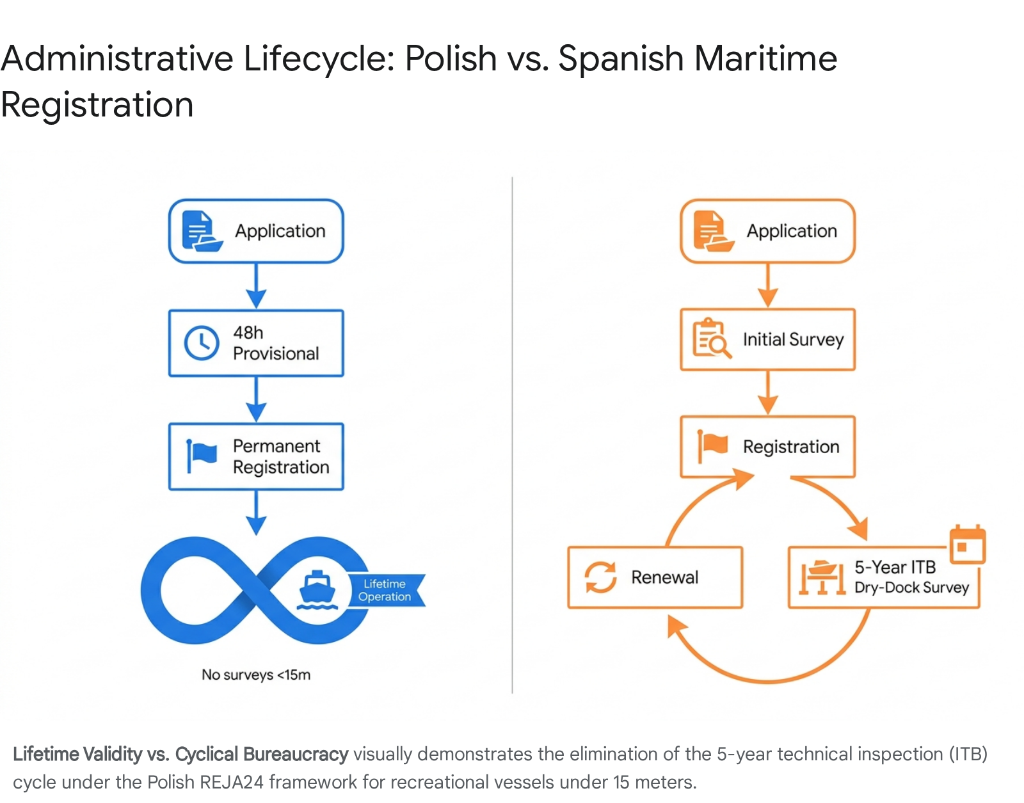
Spain imposes a highly aggressive Special Tax on Certain Means of Transport, universally referred to as the Impuesto Especial sobre Determinados Medios de Transporte (IEDMT) or matriculation tax. This tax levies a flat 12% charge on the current market value of any recreational yacht exceeding 8 meters in length. Crucially, the legislation—specifically Law 38/1992—mandates that this tax applies not only to boats registering under the Spanish flag but to any vessel navigating or utilized in Spanish waters by an individual or entity classed as a resident of Spain.
An individual is deemed a Spanish tax resident if they spend more than 183 days in the country within a single calendar year, or if their primary center of economic interest lies in Spain. Consequently, a British or US expatriate living in Alicante who purchases a 12-meter yacht, registers it in Poland, and moors it in a Spanish marina is legally obligated to declare and pay the 12% IEDMT to the Agencia Tributaria within 30 days of commencing use of the vessel in Spanish waters. Authorities do not monitor the flag; they monitor the individual. Failure to voluntarily liquidate this tax results in severe penalties, accumulating interest, and the potential seizure of the vessel by the Guardia Civil del Mar or Customs authorities.
The 60-Day Relocation Exemption Window
For international citizens planning a formal relocation to Spain, a highly specific and time-sensitive tax exemption exists that can save tens of thousands of euros. Under Article 66 of the Matriculation Tax Law, individuals moving their primary residence to Spain may import their foreign-flagged vessel without paying the 12% IEDMT, provided they meet rigorous criteria. The individual must have permanently resided outside of Spain for at least 12 consecutive months prior to the relocation, and the vessel must have been acquired under normal tax conditions (with VAT paid) in the country of origin, having been used by the individual for a minimum of 6 months prior to leaving their former country.
The most critical factor is the application deadline. The request for the matriculation tax exemption must be formally submitted to the Spanish tax authorities within a strict maximum of 60 days from the date of establishing formal residency in Spain. Missing this 60-day window results in the irrevocable forfeiture of the exemption, triggering an immediate 12% tax liability on the vessel's market value, regardless of its Polish or UK flag.
Navigating Broader Expatriate Wealth and Acquisition Taxes
The decision to base a yacht in Spain is inextricably linked to the broader fiscal profile of the expatriate. Spain taxes the worldwide income and assets of its residents. High-net-worth individuals relocating to Spain must navigate the Wealth Tax (Impuesto sobre el Patrimonio), which is calculated on global net wealth, including the valuation of luxury assets such as yachts. Furthermore, residents holding assets abroad—including bank accounts, properties, or corporately held yachts—must comply with the mandatory Modelo 720 declaration for foreign assets exceeding €50,000, ensuring complete financial transparency with the state.
A powerful tool for incoming expatriates is the Special Expatriate Tax Regime, widely known as the Beckham Law. Designed to attract international talent, this regime allows qualifying professionals to pay a flat 24% income tax rate on Spanish-sourced income up to €600,000 for their first six years of residency, exempting most foreign-sourced income and limiting Wealth Tax applications solely to assets located within Spain.
| Transaction Type | Applicable Tax | Standard Rate | Description |
|---|---|---|---|
| New Vessel Purchase | VAT (IVA) | 21% | Applied to brand-new vessels from a dealership or shipyard. |
| Second-Hand (Broker) | VAT (IVA) | 21% | Applied when purchasing a used vessel from a registered maritime professional or broker. |
| Second-Hand (Private) | Property Transfer Tax (ITP) | 4% – 11% | Applied to private transactions between individuals. Rate determined by autonomous community. |
It is a fundamental principle of Spanish tax law that a single transaction cannot be subject to both VAT and ITP simultaneously; the buyer will only pay one or the other based on the seller's classification.
Safety, Compliance, and the 12-Mile Limit: Royal Decree 339/2021
Parallel to enforcing fiscal compliance, the Spanish government has moved aggressively to close the "safety loophole" historically exploited by residents utilizing foreign flags. For years, Spanish owners flagged their vessels abroad to avoid purchasing the highly specific, DGMM-homologated safety equipment required by the Spanish register, opting instead for more affordable, internationally CE-marked or ISO-certified gear.
The promulgation of Royal Decree 339/2021 radically altered this operational landscape. The decree explicitly extends Spain's stringent safety equipment and pollution prevention regulations to any recreational vessel navigating in Spanish territorial waters (up to 12 nautical miles from the coast), regardless of its flag state, if the owner or user is a resident or holds a registered office in Spain.
For the expatriate utilizing a Polish boat registration in Spain, the implications are absolute: if you reside in Spain, your Polish-flagged vessel must carry the exact safety inventory—including specific life rafts, flares, EPIRBs, and specialized life jackets—mandated by Spanish law when navigating within the 12-mile territorial limit. The Guardia Civil del Mar actively enforces this decree on the water. While the Polish flag legally shields the vessel from the bureaucratic five-year ITB dry-dock inspection, it provides zero protection against on-the-water safety checks. Non-compliance with Spanish safety standards by a resident results in severe maritime fines, completely neutralizing the perceived equipment-cost advantages of the foreign flag.
Nautical Qualifications and Operator Certifications
Another area of constant friction involves the validity of nautical qualifications for operating foreign-flagged vessels. Prior to 2021, Royal Yachting Association (RYA) certificates were universally accepted across the European Union. Since the UK's transition to a third country, the acceptance of UK certificates in Spanish legislation has shifted. For a UK national or resident attempting to operate a Spanish-flagged vessel, Spanish maritime authorities now generally require the individual to obtain a domestic Spanish qualification, such as the Patrón de Embarcaciones de Recreo (PER).
When navigating under the Polish flag, the regulations of Poland apply. Poland broadly recognizes international qualifications, including the International Certificate of Competence (ICC), which is highly recommended for British citizens operating UK or foreign-flagged vessels in European waters. Nonetheless, expatriates residing permanently in Spain must be vigilant, as operating a vessel on an expired or unrecognized license invalidates maritime insurance policies and exposes the operator to immense liability in the event of an incident.
Commercial Exploitation: The Divergence of Polish and Spanish Law
For international operators seeking to generate revenue through bareboat or crewed yacht charters, the strategic calculus regarding flag choice shifts entirely. The administrative leniency afforded to private recreational vessels under the Polish REJA24 system evaporates immediately when a vessel is designated for commercial use.
Polish Commercial Requirements (JK Status)
Under Polish maritime law, utilizing a recreational yacht (coded "JR") for commercial purposes without explicit commercial registration is strictly prohibited and invalidates the vessel's legal standing. Registering a commercial yacht, designated under the code "JK", mandates a comprehensive Yacht Safety Certificate. Unlike the recreational tier, this certification requires a rigorous physical safety inspection conducted by a recognized organization, such as the Polish Register of Shipping (PRS), irrespective of the vessel's length. For a foreign operator based in the Mediterranean, flying specialized surveyors from recognized organizations to inspect the vessel significantly inflates operational costs, effectively negating the primary administrative advantages of the Polish system.
Spanish Charter Regulations (Lista 6)
Conversely, Spain operates a highly structured, albeit bureaucratic, commercial registry known as Lista 6. Spain has recently introduced comprehensive maritime reforms, effective in late 2025 and 2026, which impose stricter documentation and operational standards for charter providers. Crucially, from a fiscal perspective, vessels effectively and exclusively utilized for commercial charter activities in Spain are universally exempt from the 12% IEDMT matriculation tax. For commercial operators, the Spanish registry often proves more operationally cohesive, legally transparent, and financially advantageous than attempting to manage a Polish commercial (JK) certification remotely.
Navigating Post-Brexit Europe: Temporary Admission and Customs
The Polish flag grants a vessel EU nationality, allowing it to move freely across member states. However, the flag does not inherently alter the vessel's customs status regarding Value Added Tax (VAT), a distinction that is critical for UK citizens navigating the complexities of post-Brexit Europe.
When a non-EU resident brings a non-VAT-paid vessel into European Union waters, they are subject to the Temporary Admission (TA) customs regime. TA permits the vessel to navigate within the EU customs territory for a maximum continuous period of 18 months without triggering customs duties or VAT liabilities, provided the vessel is used strictly for private purposes.
The intersection of flag state and ownership structure here is paramount. If a UK citizen utilizes a dormant UK Ltd. to secure a Polish flag, the vessel technically holds EU nationality. However, if the underlying ultimate beneficial owner is a non-EU resident and VAT has not been liquidated within the EU, the vessel remains subject to the strict 18-month TA clock. Upon the expiration of the 18 months, the vessel must physically exit EU territorial waters—routing to destinations such as Gibraltar, Morocco, or Montenegro—to "reset the clock" and discharge the temporary admission procedure. Vessel owners must meticulously document their marina receipts, transit logs, and customs declarations to prove their movements.
Simultaneously, UK crew members must navigate the stringent Schengen Area immigration rules, which limit third-country nationals to a maximum stay of 90 days within any rolling 180-day period. Overstaying this limit can result in severe fines or deportation. For UK-owned vessels returning to British waters, owners must also navigate Returned Goods Relief (RGR) protocols, ensuring the vessel has not undergone significant modifications while abroad to avoid incurring double VAT taxation upon re-entry.
The Horizon: 2026 REJA24 Regulatory Reforms
The rapid expansion of the Polish registry—now encompassing over 92,000 vessels globally—has inevitably attracted intense scrutiny from international maritime bodies regarding quality control and safety standards. In response to this explosive growth and the massive influx of foreign vessels, the Polish Ministry of Infrastructure has drafted comprehensive legislative amendments intended to overhaul the REJA24 system, with implementation anticipated throughout 2026.
These proposed reforms threaten to significantly narrow the administrative gap between the Polish and Spanish systems. The most critical anticipated change is the introduction of a mandatory preliminary technical inspection for all vessels applying for new registration. This process, projected to be conducted by recognized maritime surveying organizations, is designed to verify the physical safety and structural integrity of the craft before the flag is granted. This move effectively dismantles the "no-survey" loophole that initially drove the registry's immense popularity among international owners of smaller vessels.
Furthermore, the foundational concept of a true "lifetime" registration is expected to evolve. Draft legislation points toward the implementation of a system for periodic data verification, requiring owners to officially reconfirm their vessel's status and ownership details at structured intervals, potentially every five years. While these impending regulations are currently in the developmental phase, they signal a definitive end to the era of entirely deregulated European flagging. International boat owners currently evaluating the Polish registry must factor these anticipated 2026 reforms into their strategic planning, recognizing that while Poland may remain more efficient than the Spanish ITB system, it will no longer function as an entirely inspection-free jurisdiction.
Strategic Conclusions
The evaluation of the Polish flag versus the Spanish flag reveals that there is no singular, universal solution. The optimal maritime registry is entirely dependent on the owner's residency status, the vessel's primary operational use, and the owner's nationality.
The Polish flag remains a formidable advantage for non-resident EU citizens engaging in private recreational use, offering a highly efficient, low-cost administrative solution that bypasses the friction of localized registries. For non-EU and post-Brexit UK citizens, the Polish flag—accessed via a dormant corporate wrapper—provides vital EU nationality for the vessel, though owners must proactively manage their 18-month Temporary Admission customs clock to avoid devastating VAT assessments upon port entry.
For the expatriate residing in Spain, the administrative allure of the Polish flag is heavily mitigated by domestic tax law. Residents must liquidate the 12% IEDMT on vessels over 8 meters and are strictly bound by the safety equipment mandates of Spanish Royal Decree 339/2021 when navigating within territorial waters. For these individuals, the primary remaining benefit is the avoidance of the 5-year ITB dry-dock inspection cycle.
Conversely, commercial operators seeking to engage in charter activities in the Mediterranean should generally prioritize the Spanish registry (Lista 6). The rigorous safety requirements for Polish commercial (JK) yachts negate the registry's primary benefits, making local Spanish oversight more logistically sound and commercially viable, particularly given the available IEDMT exemptions for charter vessels. As the Polish authorities prepare to introduce technical inspections in 2026, vessel owners must pivot from seeking absolute deregulation toward adopting highly compliant, strategically structured maritime ownership models tailored to their specific operational footprints.
Polish Boat Registration
Step-by-step guide to registering your vessel under the Polish flag.
Pricing & Fees
Transparent pricing for Polish yacht registration packages.
Yacht Registration Poland
Documentation, requirements, and complete process explained.
Help Center & FAQ
MMSI, documentation, timelines, and much more.
Ready to Switch to the Polish Flag?
We handle the entire process for you in 24-48 hours. No upfront payment required.